
Loading
 ← Back to blogs
Learn customer journey mapping for digital marketers, explore key stages, understand customer behavior, and create better marketing strategies.
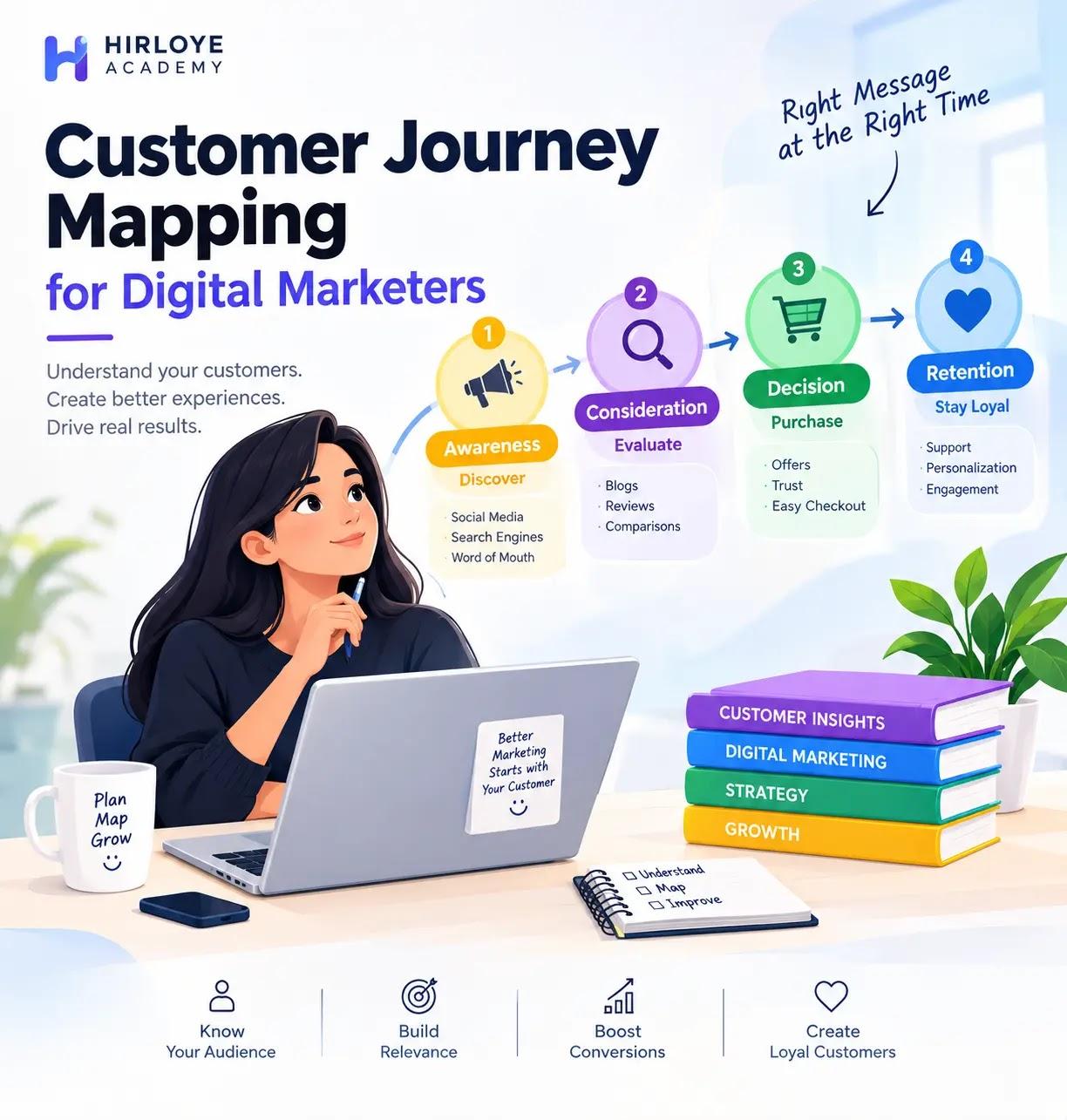
In digital marketing, attracting visitors to a website is only the beginning. Businesses also need to understand what customers do before making a purchase, what influences their decisions, and what encourages them to return .
This is where customer journey mapping becomes important. It helps digital marketers understand how people discover a business, explore its products or services, make purchasing decisions, and interact with the brand after buying.
Whether you are a student learning digital marketing, a beginner exploring marketing careers, or a business owner looking to improve conversions, understanding customer journey mapping can help you build more effective marketing strategies.
In this beginner's guide, we will explore the customer journey, its key stages, practical mapping techniques, useful tools, and real-world examples.
1.What Is Customer Journey Mapping?
2.Why Is Customer Journey Mapping Important?
3.The Five Stages of the Customer Journey
4.Key Elements of a Customer Journey Map
5.How to Create a Customer Journey Map: Step-by-Step
6.Customer Journey Mapping Example
7.Best Tools for Customer Journey Mapping
8.Common Customer Journey Mapping Mistakes
9.How Digital Marketers Can Improve the Customer Journey
10.Frequently Asked Questions (FAQs)
11.Conclusion
Customer journey mapping is the process of visually representing the steps a customer takes when interacting with a business, from the first discovery of a brand to purchasing a product and potentially becoming a loyal customer.
It helps marketers understand the customer's actions, questions, expectations, emotions, and challenges at each stage of the buying process.
For example, imagine someone searching Google for the best digital marketing course in Chennai. They discover a training academy, visit its website, compare course details, check reviews, contact the academy, and eventually enrol.
Each interaction is part of that person's customer journey.
A customer journey map organizes these interactions so marketers can identify what works well and where improvements are needed.
The primary purpose is to understand the customer experience from the customer's perspective rather than focusing only on the business's marketing activities.
It helps marketers answer questions such as:
By answering these questions, businesses can create more relevant content, improve their website experience, and make better marketing decisions.
Customer journey mapping helps digital marketers understand how different marketing activities work together. Instead of treating SEO, social media, email marketing, and paid advertising as separate activities, marketers can connect them to the customer's overall experience.
A journey map helps marketers identify what customers do before taking action. For example, customers may discover a brand through Instagram but visit Google to read reviews before making a purchase.
Understanding these behaviours helps businesses plan their marketing activities more effectively.
Potential customers may leave a website because the pricing is unclear, the enquiry form is complicated, or they cannot find the information they need.
Mapping the journey can reveal these obstacles and help businesses improve their landing pages, calls to action, and enquiry processes.
Customers need different types of information at different stages.
Someone discovering a product for the first time may need an educational blog post, while someone comparing products may need a detailed comparison or customer testimonial.
Journey mapping helps marketers deliver the right content at the right time.
A confusing website, slow response to enquiries, or unclear purchase process can discourage customers.
A journey map helps businesses identify these problems and create a smoother experience across digital channels.
When customer interactions are mapped against journey stages, marketers can select suitable metrics to understand performance.
For example, website traffic can help measure awareness, enquiry rates can indicate consideration, and conversion rates can help evaluate purchasing activity.
10
A common customer journey model includes five stages: awareness, consideration, decision, retention, and advocacy. Real customer journeys are not always linear, and customers may revisit earlier stages before making a decision.
Awareness begins when a potential customer discovers a business, product, or service.
The customer may not be ready to buy. They are often identifying a problem, exploring a topic, or learning about possible solutions.
Digital marketing activities:
Example: A student sees an Instagram reel explaining career opportunities in digital marketing.
Useful metrics: Reach, impressions, website visits, and brand searches.
During consideration, customers explore possible solutions and compare available options.
They may visit websites, read articles, watch demonstrations, compare prices, and check reviews before deciding what suits their needs.
Digital marketing activities:
Example: The student visits several academy websites to compare course modules, fees, practical training, and certification.
Useful metrics: Engaged website sessions, returning visitors, course-page views, and enquiry clicks.
At the decision stage, customers are close to taking action. They may need final information or reassurance before purchasing.
Digital marketing activities:
Example: The student contacts an academy to ask about course fees, class timings, and practical projects before enrolling.
Useful metrics: Lead conversion rate, enquiry-to-sale rate, completed purchases, and cost per acquisition.
The customer journey does not end after a purchase. Retention focuses on helping customers receive value and encouraging them to continue their relationship with the business.
Digital marketing activities:
Example: After enrolling in a digital marketing course, a student receives learning resources, task instructions, and progress updates.
Useful metrics: Repeat purchases, renewal rate, engagement, and customer retention rate.
Advocacy happens when satisfied customers voluntarily recommend a business, share their experiences, or leave positive reviews.
Not every customer becomes an advocate, but a good experience can make recommendations more likely.
Digital marketing activities:
Example: A student who has had a positive learning experience recommends the academy to a friend.
Useful metrics: Referral enquiries, review volume, customer recommendations, and customer satisfaction.
A useful customer journey map includes more than a list of stages. It connects the customer's experience with the marketing channels and business actions that influence it.
The following elements are especially important.
A customer persona is a research-based profile representing a particular customer group. It may include goals, challenges, preferences, and decision-making habits.
For example, a persona for a digital marketing academy might be a college graduate seeking practical skills and entry-level job opportunities.
Touchpoints are the interactions customers have with a business.
Examples include:
These are the steps customers take at each stage, such as watching a video, reading a blog, comparing prices, submitting a form, or making a purchase.
Customers may feel curious, confused, uncertain, or confident at different points in their journey.
Understanding these reactions helps marketers identify where additional information or support may be useful.
Pain points are obstacles that make the customer experience difficult. These could include unclear pricing, slow website loading, missing information, or complicated booking forms.
The map should identify possible improvements and the metrics that will help measure their impact.
For example, if many visitors abandon a course enquiry form, a marketer could simplify the form and measure whether completion rates improve.
10
Follow these steps to create a practical customer journey map.
Start by deciding what you want to understand or improve.
Your goal could be to increase website enquiries, reduce shopping cart abandonment, improve course registrations, or increase repeat purchases.
A clear goal keeps the mapping process focused.
Understand who your customers are, what they want, and what problems they are trying to solve.
Use customer interviews, surveys, website analytics, enquiry records, and feedback to build a realistic picture of their behaviour.
Avoid relying entirely on assumptions.
Gather information from relevant sources, such as:
Use data that you are authorized to access, and respect customer privacy.
Identify where customers interact with your business before, during, and after a purchase.
Include both online and offline interactions when relevant. A customer might discover a business through an advertisement, visit its website, call the sales team, and then complete a purchase in person.
Arrange the touchpoints under the appropriate stages: awareness, consideration, decision, retention, and advocacy.
Remember that customers may move between stages or use multiple channels before taking action.
Look for places where customers struggle or leave the journey.
For example:
Use analytics and customer feedback to validate the problem before deciding what to change.
Match each pain point with a practical action.
If visitors cannot find pricing, make the pricing information easier to locate. If leads are waiting too long for a response, improve the follow-up process.
Prioritize changes based on customer impact, effort, and available evidence.
Track the metrics connected to your goal and compare results over time.
Customer expectations, marketing channels, and business processes change, so your journey map should be reviewed and updated regularly.
Let's look at a practical example of a digital marketing academy attracting a prospective student.
Journey stage | Customer action | Marketing touchpoint | Opportunity |
Awareness | Discovers digital marketing | Instagram reel | Publish useful career-focused content |
Consideration | Compares training options | Website and blog | Explain curriculum, practical training, and fees |
Decision | Asks questions before joining | WhatsApp or enquiry form | Provide a clear, timely response |
Retention | Starts learning | Learning dashboard and email | Offer guidance and progress updates |
Advocacy | Shares a positive experience | Review or referral | Make it easy to leave honest feedback |
This example shows how different marketing activities support the same customer journey.
The social media reel attracts attention, the website helps the student evaluate the course, the enquiry process supports the decision, and the learning experience influences retention and recommendations.
Key takeaway: Customer journey mapping helps marketers connect individual touchpoints into a consistent customer experience.
You do not need expensive software to create your first customer journey map. Start with tools that help you understand customer behaviour and organize your findings.
Google Analytics 4
Helps analyze website traffic, engagement, and key events. Marketers can use these insights to understand how visitors interact with a website.
Google Search Console
Helps identify search queries, impressions, clicks, and landing-page performance from Google Search.
Microsoft Clarity
Provides tools such as session recordings and heatmaps to help investigate how visitors interact with web pages.
Miro
Can be used to organize customer touchpoints, map journey stages, and collaborate on visual journey diagrams.
HubSpot CRM
Helps manage customer and lead interactions, track sales activities, and organize follow-up processes, depending on the features used.
Tool availability and features can vary by plan. For beginners, a spreadsheet or simple whiteboard is often enough to get started.
Even a well-designed map can be ineffective if it does not reflect real customer behaviour.
Marketers sometimes assume they know what customers want without collecting evidence. Use feedback, analytics, and customer conversations to validate your ideas.
The customer experience continues after a sale. Ignoring onboarding, support, retention, and referrals can leave important opportunities unexplored.
Different customers may have different goals, budgets, and expectations. A single map may not accurately represent every audience segment.
Create separate maps when meaningful differences in behaviour justify them.
Customers may discover a brand, leave, return through another channel, and compare alternatives before buying. A map should reflect this complexity where relevant.
A journey map is useful only when it informs decisions. Prioritize specific improvements, assign responsibility, and measure whether the changes make a difference.
Once you understand the journey, you can use it to improve your marketing strategy.
The goal is not simply to push customers toward a sale. It is to make each interaction more useful, relevant, and convenient.
Customer journey mapping is the process of visually outlining how customers discover, evaluate, purchase from, and interact with a business after a purchase. It helps marketers understand touchpoints, customer needs, and opportunities to improve the experience.
A common model includes awareness, consideration, decision, retention, and advocacy. These stages describe how customers may move from discovering a brand to becoming repeat customers and recommending it to others.
It helps marketers identify customer pain points, improve conversion opportunities, create relevant content, coordinate marketing channels, and build a better customer experience.
Common options include Google Analytics 4, Google Search Console, Microsoft Clarity, Miro, and HubSpot CRM. Spreadsheets and whiteboards can also be used to create a basic map.
Yes. Beginners can use a simple table to list journey stages, customer actions, touchpoints, pain points, and potential improvements. Advanced software is not necessary to understand the fundamentals.
Review it whenever customer behaviour, business processes, or marketing strategies change significantly. Regular reviews of analytics and customer feedback help keep the map useful and accurate.
Customer journey mapping is an important skill for digital marketers because it helps them understand the complete customer experience rather than focusing on isolated marketing activities.
By identifying the stages customers move through, analyzing touchpoints, understanding pain points, and measuring results, businesses can create more relevant campaigns and improve the experience from discovery to retention.
For beginners, the best approach is to start with one audience, define a clear goal, map the major touchpoints, and use real data to identify improvements.
If you want to build practical knowledge of SEO, social media marketing, Google Ads, content strategy, and other digital marketing skills, explore the learning opportunities at Hirloye Academy.
Learn the concepts, practise with real-world tasks, and build the skills needed to apply digital marketing strategies with confidence,

Learn what Digital Marketing is, its types, benefits, career opportunities, AI trends, and why it's one of the most in-demand skills for students and professionals in 2026.

Discover the benefits of learning Digital Marketing after college, explore career opportunities, essential skills, freelancing, and how to build a successful Digital Marketing Career.

Explore the top 10 Digital Marketing Skills every student should master, from SEO and Google Ads to AI tools, to build a successful Marketing Skills portfolio and career.

