
Loading
 ← Back to blogs
Learn target audience research. Find your ideal customers. Understand their needs. Build effective digital marketing strategies with this beginner's guide.
In digital marketing, reaching more people does not always mean getting better results. A business can have thousands of social media followers or website visitors. Yet it may still struggle to generate leads and sales. The reason is often simple: it may not be reaching the right audience.
Target audience research helps businesses learn who their potential customers are. It shows what they need, what problems they face, and how they decide to buy. This information helps marketers create relevant content.
It helps them improve ad campaigns.
It also helps them reach people who are likely to become customers.
Whether you are a student, beginner in digital marketing, entrepreneur, or business owner, understanding your target audience is an essential marketing skill. In this guide, you will learn what target audience research is, why it matters, how to conduct it, and which tools can help you identify your ideal customers.
Table of Contents: Target Audience Research – A Beginner’s Guide
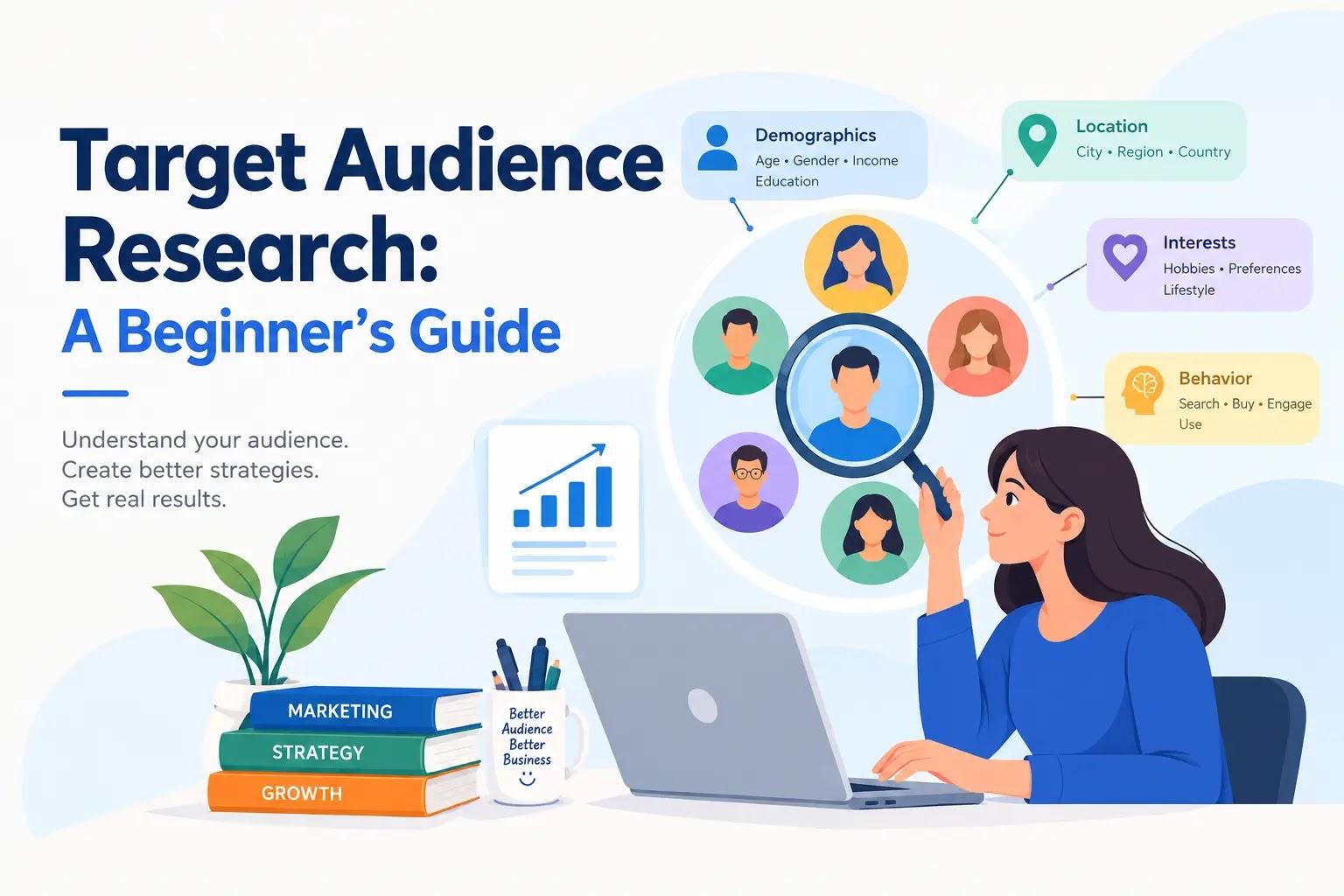
Target audience research is the process of gathering and studying information about people. These people are most likely to want a business's products or services.
It helps marketers understand their audience's demographics, interests, online behavior, challenges, preferences, and buying habits.What Is Digital Marketing?
For example, a digital marketing academy in Chennai offers hands-on training for college students.
It may define its target audience as students, recent graduates, and beginners.
These learners want to build digital marketing skills and improve their job prospects.For example, a digital marketing academy in Chennai offering practical training to college students may identify its target audience as students, fresh graduates, and beginners who want to develop digital marketing skills and improve their employment opportunities.
By understanding this audience, the academy can create relevant course content, educational social media posts, and advertising campaigns that address students' actual needs.
A target audience is a specific group of people a business wants to reach through its marketing activities.
Businesses define their target audience based on factors such as:
Defining these characteristics helps businesses make more informed marketing decisions instead of targeting everyone.
Understanding your audience is the foundation of an effective digital marketing strategy. Without research, marketers may spend time and money creating content that does not connect with potential customers.
When you know your audience’s questions and interests, you can create blog posts, videos, social posts, and ads. These can meet their needs.
For example, some students like digital marketing.
They may find content about careers, projects, internships, and interview prep more useful.
They may find it more useful than general promotional posts.
Audience research helps businesses identify the people most likely to respond to their advertisements.
Marketers can use relevant audience insights to improve campaign targeting, messaging, and landing pages.
They can apply these insights across platforms like Google Ads and Meta Ads.
Reaching people who genuinely need a product or service can improve lead quality.
Instead of focusing only on the number of enquiries, businesses can prioritize potential customers whose requirements match their offerings.
Research reveals the problems, expectations, and preferences that influence purchasing decisions.
This allows businesses to communicate benefits more clearly and answer common customer concerns.
When businesses understand their customers, they can make better decisions about products, pricing, content, promotions, and marketing channels.
Over time, this understanding can help improve customer satisfaction and marketing efficiency.
There are several ways to understand your ideal customers. Using a combination of research methods often provides a more complete picture.
Demographic research examines characteristics such as age, education, occupation, and income.
For example, a training institute may discover that its digital marketing course attracts college students and recent graduates looking for practical career skills.
Geographic research focuses on where potential customers live or work.
A local business may target people in Chennai, while an online service may reach customers across India.
Location-based research is particularly useful for local SEO, Google Business Profile optimization, and location-specific advertising.
Psychographic research explores people's interests, values, goals, motivations, and lifestyles.
For example, some students may want a digital marketing course because they want a job, while others may want to start freelancing or promote their own businesses.
Understanding these motivations helps marketers create more relevant messages.
Behavioral research examines how people interact with a business and its marketing channels.
This may include:
These insights help marketers understand what attracts attention and encourages conversions.
Follow these steps to identify and understand your ideal customers.
Start by identifying what you want your marketing to achieve.
Your goal could be to:
Your goal determines what audience information you need to collect.
If your business already has customers, examine the information you can legitimately access about them.
Look for patterns in their location, interests, common questions, purchase history, and preferred communication channels.
You can collect insights through customer feedback, surveys, interviews, and existing analytics reports. Follow applicable privacy requirements when collecting or using customer data.
Study businesses that offer similar products or services.
Observe:
Competitor research can reveal opportunities, but do not assume their audience is identical to yours.
Keyword research helps you understand what people search for when they need information, products, or services.
For example, someone interested in learning digital marketing may search for:
These searches provide clues about the audience's interests and intent.
Tools such as Google Keyword Planner, Google Trends, and Google Search Console can help you explore search demand and relevant topics.
Ask potential customers direct questions to understand their needs.
Useful questions include:
Even a small number of well-designed interviews can reveal useful insights. However, avoid assuming that a small sample represents every potential customer.
Social media platforms can help you understand what interests your audience.
Review comments, frequently asked questions, shares, saves, video engagement, and messages to identify recurring themes.
For example, if students regularly ask about practical training and job opportunities, those topics could guide future educational content.
A customer persona is a fictional profile based on research about a typical customer.
It helps marketing teams visualize the audience they want to reach and create more relevant campaigns.
Example: Digital Marketing Academy Persona
Illustrative persona, not actual customer data
Wants to gain practical skills and prepare for entry-level digital marketing opportunities.
Profile
Main challenges
Content that may appeal
Use personas as working hypotheses and refine them as you gather real audience data.
Once you understand your audience, decide where to reach them.
Audience behavior | Potential marketing channel |
Searches for solutions on Google | SEO and Google Ads |
Watches short-form videos | Instagram Reels and YouTube Shorts |
Looks for professional information | |
Reads educational content | Blogs and email newsletters |
Searches for local services | Local SEO and Google Business Profile |
Choose channels based on research and actual performance rather than following every trend.
Audience research should continue after a campaign launches.
Monitor relevant metrics such as website conversions, lead quality, engagement, click-through rates, and customer feedback.
Test different messages and content formats, then use the results to refine your audience assumptions and marketing approach.
These tools can help beginners collect and analyze audience insights.
Google Trends
Explore search interest over time, compare topics, and identify regional or seasonal patterns.
Website: trends.google.com
Google Analytics 4
Understand website and app interactions, traffic sources, and important user actions when analytics is configured.
Website: analytics.google.com
Google Keyword Planner
Discover keyword ideas and estimates of search demand for planning search advertising and content topics.
Website: ads.google.com
Google Search Console
Review search queries, clicks, impressions, and the search performance of your website.
Website: search.google.com/search-console
Microsoft Clarity
Use supported session recordings and heatmaps to better understand how visitors interact with your website. Configure consent and privacy controls appropriately.
Website: clarity.microsoft.com
Avoid these mistakes when planning your marketing strategy:
Avoiding these mistakes helps you build a more reliable, customer-focused marketing strategy.
Target audience research supports nearly every major digital marketing activity.
When these activities work together, businesses can create a more consistent experience from the first interaction to the final conversion.
Target audience research is the process of understanding potential customers' characteristics, interests, needs, and behavior so businesses can develop more effective marketing strategies.
It helps businesses create relevant content, improve advertising, generate better-qualified leads, understand customer needs, and use marketing resources more effectively.
The main approaches include demographic, geographic, psychographic, and behavioral research. Surveys, interviews, analytics, and competitor research can provide additional insights.
Google Trends, Google Analytics 4, Google Keyword Planner, Google Search Console, and Microsoft Clarity are useful tools.
They help you understand search behavior and website interactions.
Start by defining your business goals. Research potential customers. Study relevant search queries. Review competitor content. Speak directly with people who may need your product or service.
A target audience is a group of people a business wants to reach. A customer persona is a fictional profile representing a typical member of that group, based on research and evidence.
Target audience research is a key digital marketing skill. It helps businesses learn who their customers are. It also shows what customers need. It helps teams communicate in a clear, effective way.
Marketers can use customer feedback to learn more. They can also use keyword research. Competitor analysis can reveal what others are doing. Analytics tools can show what works and what does not.
With these methods, marketers can make better decisions. They can create campaigns that feel more relevant to their audience.
For students and new digital marketers, learning audience research builds a strong base for SEO. It also supports social media marketing, Google Ads, and content creation. Start with simple research methods. Write down your findings. Test your assumptions. Keep improving your strategy as you collect more data.
At Hirloye Academy, building real digital marketing skills means learning how to promote a product or service. It also means understanding the people you want to reach.

Learn what Digital Marketing is, its types, benefits, career opportunities, AI trends, and why it's one of the most in-demand skills for students and professionals in 2026.

Discover the benefits of learning Digital Marketing after college, explore career opportunities, essential skills, freelancing, and how to build a successful Digital Marketing Career.

Explore the top 10 Digital Marketing Skills every student should master, from SEO and Google Ads to AI tools, to build a successful Marketing Skills portfolio and career.